

Finishing a draft feels like an ending. It isn't. What you have is a long set of notes towards a novel, and the shaping, tightening and polishing still lie ahead. That prospect can paralyse a writer, so don't face it whole. Break the work into passes, each with a single job, and move from the largest problem down to the smallest. Correcting commas in a chapter you're about to delete is the most common way to lose three months.
Here is an order that works, and the reasoning behind it.
Pass one: structure
Read the whole manuscript quickly, ideally after leaving it alone for a fortnight. Don't correct anything yet. You are inspecting load-bearing walls.
- Does your protagonist want something concrete, and is that want different by the last page?
- Does each act turn on a decision rather than an accident?
- Does the middle escalate, or does it repeat the same argument in different rooms?
- Does the ending answer the question the opening asked?
A useful check: write one line per chapter describing what changes between its first page and its last. Chapters where nothing changes are usually filler, however pretty the sentences.
Pass two: scenes
Every scene needs a want, an obstacle and a turn. If nothing shifts, you have written a report rather than a scene. Check your entries and exits too: most drafts begin scenes too early and end them too late. Cut the greetings, the walk to the door, the settling into chairs, and start where the trouble does.
Watch for scenes that exist only to deliver information. A conversation explaining the plot is far less interesting than one in which somebody refuses to explain it. Give the reader a beat to absorb each turn before the next scene arrives; a short reaction paragraph is often enough.
Pass three: prose
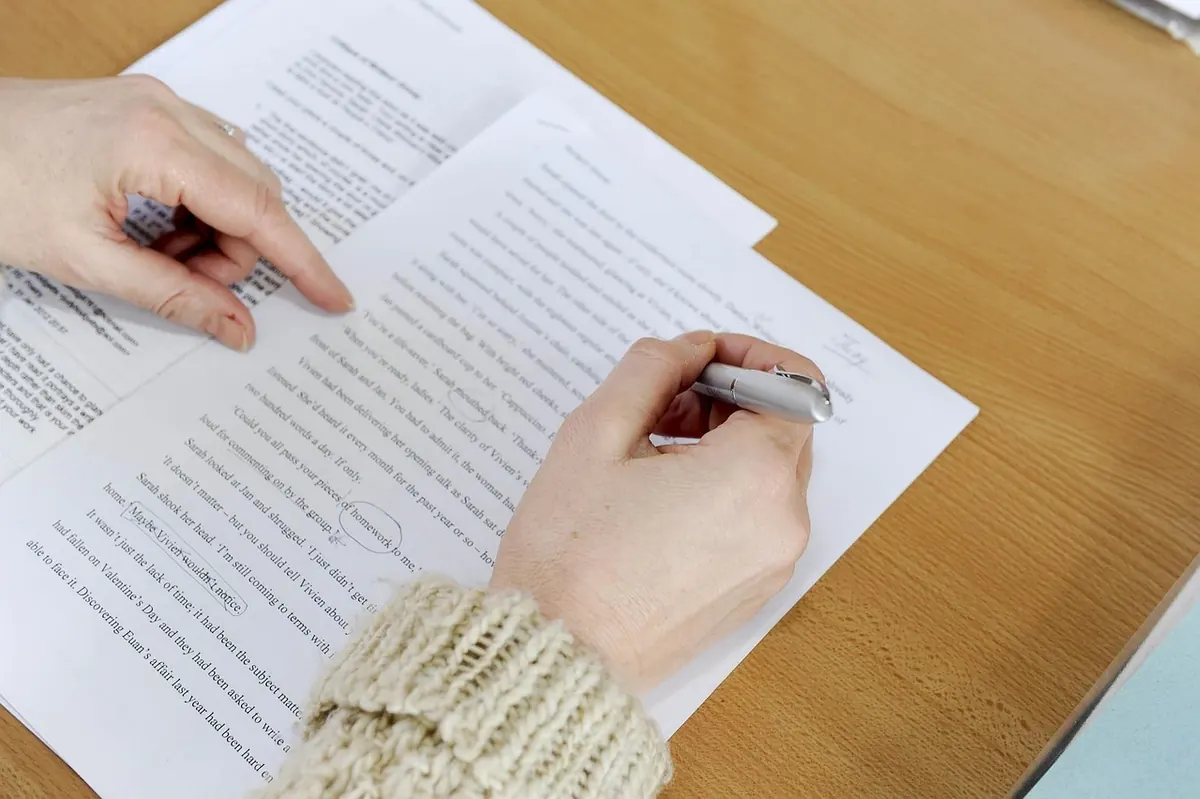
Now you can touch sentences. Read with a pen and hunt for these:
- Padding words — very, really, quite, just, somewhat. Most can go without loss.
- Filter words — she saw, he felt, she noticed, he realised. Remove the filter and put the reader inside the moment.
- Weak verb plus adverb — "walked quickly" is "hurried".
- Passive constructions that hide who did what to whom.
- Repeated shapes — three sentences opening with "She", or paragraph after paragraph of identical length.
Read the chapter aloud, or have a text-to-speech tool read it to you. Your ear catches clumsy rhythm far faster than your eye. Vary sentence length deliberately, and vary paragraph length too: short paragraphs quicken the pace, long ones slow it down.
Pass four: dialogue
Read only the spoken lines, skipping everything between them. If the conversation still makes sense, your dialogue is carrying its weight. If it collapses, you have been using narration as a crutch.
Then check three things. First, voice: could a reader tell who is speaking with the tags removed? Second, exposition: are characters telling each other facts they both already know, purely for the reader's benefit? Third, tags. Said and asked are invisible; "he chortled" and "she opined" are not. Cut stage directions that repeat the line, such as "I'm furious," she said angrily.
What matters most is what goes unsaid. Strong dialogue circles its subject rather than announcing it. If you are writing an accent, suggest the rhythm instead of spelling every vowel phonetically.
Pass five: continuity
Keep a style sheet for the whole project — a plain document listing names and their spellings, eye colours, place names, ages, job titles and any detail a reader might catch going wrong. Then read with it open beside you.
Check the timeline hardest. How many days pass? Does anyone travel an impossible distance between breakfast and lunch? Do injuries, weather and time of day persist? Has the phone in chapter three moved from a pocket into a hand by the next paragraph?
One trick: read chapters out of order. Reading chapter twelve immediately after chapter seven makes contradictions jump out, because you are no longer absorbed by the story's forward pull.
Pass six: formatting
This pass is about consistency rather than taste. Decide on each convention once, then apply it everywhere.
- Chapter headings, numbering and scene-break markers — identical in every instance.
- Quotation marks: single or double, chosen and held, with nested quotes taking the opposite form.
- Em dashes and ellipses, spaced or unspaced, used the same way throughout.
- Italics reserved for internal thought and genuine emphasis, not decoration.
- Numbers, dates and abbreviations following one style guide rather than three.
A find-and-replace sweep for double spaces, doubled punctuation and stray tabs takes minutes and saves embarrassment. If you are submitting to an agent or publisher, read their guidelines and follow them exactly, even where they differ from your preferences.
Pass seven: proofreading
Proofreading comes last, on a version you have stopped changing. Your brain reads what it expects to see, so change the conditions:
- Read aloud, slowly, following each word with a cursor.
- Read backwards, sentence by sentence, so meaning cannot carry you past mistakes.
- Change the font, size or line spacing, or read on a different device.
- Print it, if you can bear the paper.
- Ask a fresh reader to mark anything that trips them.
Hunt the usual suspects: its and it's, their and there, led and lead, affect and effect, compliment and complement, discreet and discrete. Look for doubled words, missing words and mispunctuated dialogue. Settle hyphenation too — well known or well-known — and choose one spelling system, British or American, rather than drifting between them.
Keeping the passes manageable
One pass, one job. If you catch yourself fixing commas during the structure read, stop and make a note instead. Time-box each pass: an hour a day for three weeks finishes far more than a heroic weekend that leaves you exhausted. Keep a cut file for anything you remove, so deleting never feels final.
Know when to stop. When a full pass produces nothing but nitpicks, the manuscript is ready for someone else's eyes, and no writer can see their own book clearly enough to replace that. What you can control is this: making sure it reaches your reader clean, coherent and finished.
Photo: WokinghamLibraries / Pixabay