




A short story is not a novel with the middle cut out. It is one deliberate movement: someone wants something, something stands in the way, and by the last line the ground has shifted beneath them. That is the whole trick, and it is harder than it sounds. The encouraging part is that the difficulty is a craft problem rather than a talent problem, and craft problems have steps. What follows is a route from a half-formed idea to a draft you would be happy to send out.
Find a premise with pressure already in it
A premise is not a plot. A plot is a sequence of events; a premise is a situation that is already uncomfortable. "A woman clears out her father's flat" is a situation. "A woman clearing out her father's flat finds a stack of unopened letters addressed to her in his handwriting" is a premise, because it arrives with a want attached: she needs to know why.
Test your idea against two questions. Is there a clear want? Is there an obstacle strong enough to make the want difficult? If both answers are yes, you have enough to start. If either is no, you have a mood, not a story.
Write six premises in ten minutes without judging them. Keep the two that make you curious enough to daydream about. Then check the scale: most short stories run between 1,000 and 7,500 words, so your premise needs to be small enough to resolve in a handful of scenes. A family argument is a short story. A dynasty is a novel.
Build a character who wants something specific
Vague characters produce vague stories. Give yours three things before you write a word of dialogue:
- An external want — concrete and achievable within the story. Not "to be happy" but "to get the deposit back before Friday".
- An internal need — what they would understand about themselves if the story went well. Often they are wrong about this at the start.
- A belief that is not quite true — "If I had been a better daughter, he would have told me." This belief is what the story will test.
Add one physical habit, one object they carry, and one thing they do when they are nervous. That is usually more revealing than a paragraph of description. Resist the mirror scene; character appears through choices made under pressure, not through hair colour.
Keep the cast small. Two or three named characters is comfortable for a short story. Every extra name costs you words you will want later.
Make the conflict sharp and specific
Conflict does not mean shouting. It means two forces that cannot both get what they want. Two sisters dividing their mother's belongings is not conflict unless the necklace was promised to both of them. Now something has to give.
Three shapes cover most short fiction: person against person, person against circumstance, and person against themselves. The third is the hardest to dramatise, because it can slide into a character simply thinking about their problem. Give an internal conflict an outer shape — a phone call that must be made, a form that must be signed — so readers can watch it happen rather than be told about it.
Then escalate. Each attempt your character makes should cost something or close a door. If they can try the same thing twice with no consequence, the scene is marking time.
Structure scenes that turn
A scene is not a chapter. It happens in one place, at roughly one time, with a goal in play. Most effective short stories contain three to five of them, stitched together with brief passages of summary that move time forward.
What every scene needs
- A goal: what the viewpoint character wants from this conversation or encounter.
- An obstacle: who or what refuses to cooperate.
- A turn: by the end, something has changed — a decision, a revelation, a relationship.
- An exit: a reason to keep reading.
Enter late, leave early
Beginners write the doorbell, the small talk and the goodbye. Start as close to the argument as you can bear, and stop the moment the news lands. A useful exercise: delete the first and last paragraph of every scene, then read it back. Nine times out of ten, nothing is lost and the pace improves.
Write each scene's purpose as a single sentence before you draft it: Mara asks her brother for the keys. He refuses. She takes them anyway. If you cannot write that sentence, the scene is not ready.
Get a messy first draft down
Drafting and editing use different parts of the brain, so do not attempt both at once. Write the whole story through, scene by scene, without fixing anything. When you need a fact you do not have, leave a marker in square brackets — [what a harbour smells like at five in the morning] — and keep going. Keep a separate file for these notes so the story itself stays clean.
Expect the first draft to be thinner and stranger than you imagined. That is normal and it is not a verdict on the idea.
Revise in passes, not all at once
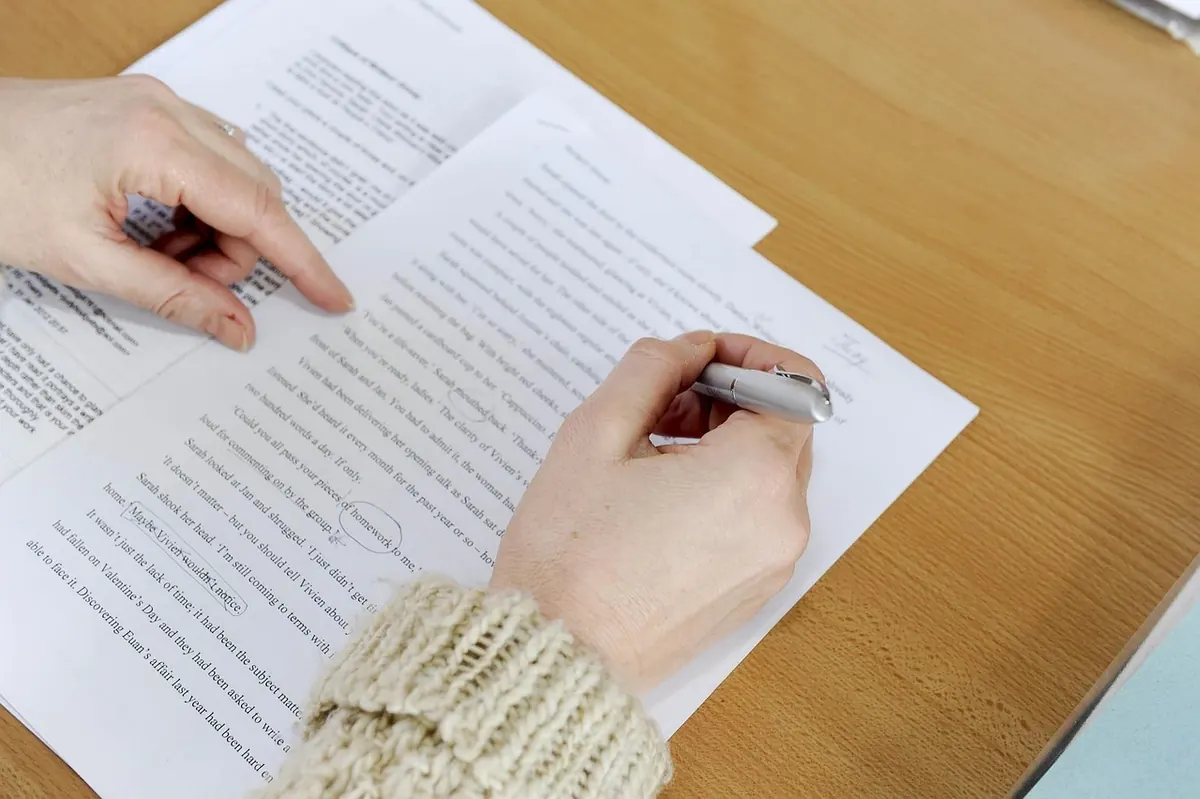
Put the draft away for at least a day, longer if you can manage it. Distance is the cheapest editing tool available, and it works. When you return, tackle one layer at a time rather than trying to hold the whole story in your head.
- Structure pass. Read only the first and last line of each scene. Does something shift in every one?
- Character pass. Does your protagonist make at least one decision that is surprising but earned?
- Scene pass. Trim the run-up. Cut the first and last paragraph of each scene and see what survives.
- Language pass. Read for rhythm. Cut adverbs, swap abstract nouns for concrete ones, and replace any phrase you have read before with one you have not.
- Aloud pass. Read the whole story out loud. Awkward sentences will announce themselves.
When you want outside eyes, give your reader two questions instead of one. Ask where they got bored, and ask what they thought was going to happen. "Is it good?" invites politeness; those two questions invite information.
Finish one, then start the next
Short stories are learned by completing them, not by planning them. Set yourself a date, however arbitrary, and work towards it. Keep a running list of premises in a notebook so that when one story is finished you are not staring at a blank page wondering what to write.
Send the story out when you have reached the point where a week of tinkering would only move commas around. Then begin something new. The second story will be easier than the first, and the fifth will be easier still — not because you have found a secret, but because you have practised the steps enough times that they no longer need thinking about.
Photo: kaboompics / Pixabay